Tumbler Quality Control Checklist for Bulk Orders: What Smart Buyers Check Before Shipment
If you’ve ever placed a bulk tumbler order, you probably already know the real risk isn’t always the quoted price.
It’s what happens after production starts.
On paper, everything can look fine. The sample looks good. The photos from the supplier look good too. But once mass production is underway, that’s when the small issues start showing up—scratches on the surface, coating that doesn’t look even, lids that don’t seal well, logos printed slightly off-center, or cartons that look okay in the factory but fall apart during shipping.
And the worst part is this: a lot of buyers only find those problems when the order is already packed, or even after it reaches the warehouse.
That’s why having a real tumbler quality control checklist bulk orders process matters so much. Not just a vague “please check quality,” but an actual checklist that tells everyone what needs to be inspected, what counts as acceptable, and what should stop the shipment.
This article walks through the things worth checking before your tumblers leave the factory, especially if you’re buying for resale, Amazon, promotional gifting, or your own private label brand
Why Quality Control Becomes a Bigger Deal in Bulk Orders
With small orders, a few imperfect pieces might be annoying, but manageable.
With bulk orders, small issues don’t stay small for long.
Let’s say your order is 1,000 tumblers. If just 3% of them have leaking lids, that’s 30 units already creating trouble. If 5% have visible logo defects, now you’re looking at negative reviews, replacement costs, customer complaints, and probably a frustrating conversation with your supplier.
For Amazon sellers, that can turn into return issues and poor ratings fast. For promotional gift buyers, even one wrong logo batch can damage how the brand is perceived. For wholesalers, defects mean extra sorting, repacking, and delays that eat straight into margin.
That’s why experienced buyers don’t treat QC as a last-minute formality. They use it as a way to control risk before the shipment leaves.
If you want to see how structured factory inspection usually works, this page is a useful reference: tumbler production and quality control services.
What a Good Tumbler QC Checklist Actually Does
A lot of people think QC just means opening a few cartons and checking whether the tumblers “look okay.” That’s not enough.
A useful tumbler quality control checklist bulk orders should answer a few practical questions:
- Are the materials consistent with the approved sample?
- Is the body finish clean and even?
- Are the logo and print details correct?
- Do the lids fit properly and seal well?
- Is the packaging strong enough for shipping and storage?
- Are the inspected units representative of the whole batch?
That’s the real value of a checklist. It turns “good quality” into something visible and measurable.
Because once expectations stay vague, almost everything becomes open to interpretation.
The Main Stages of Quality Control in Bulk Tumbler Orders
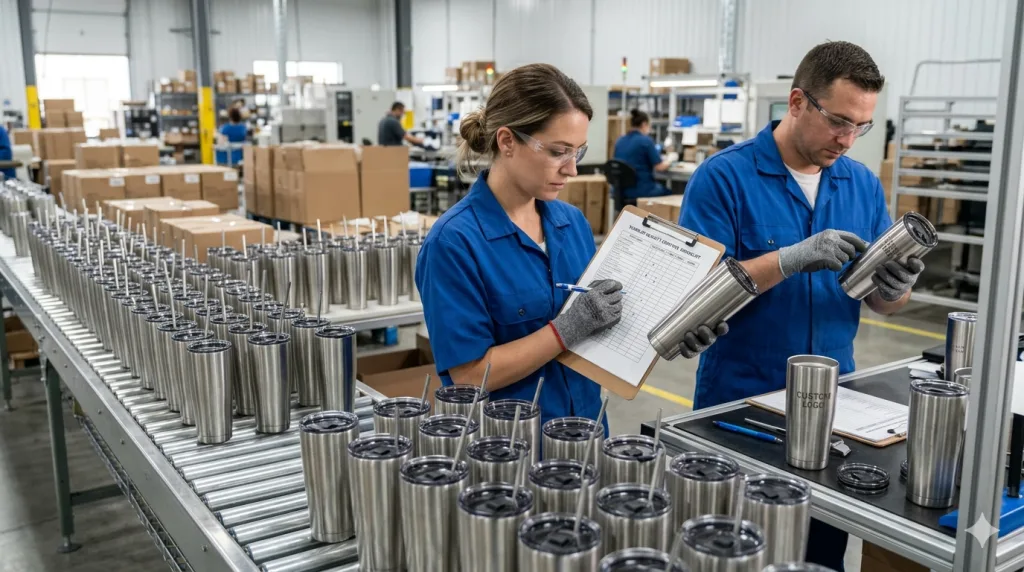
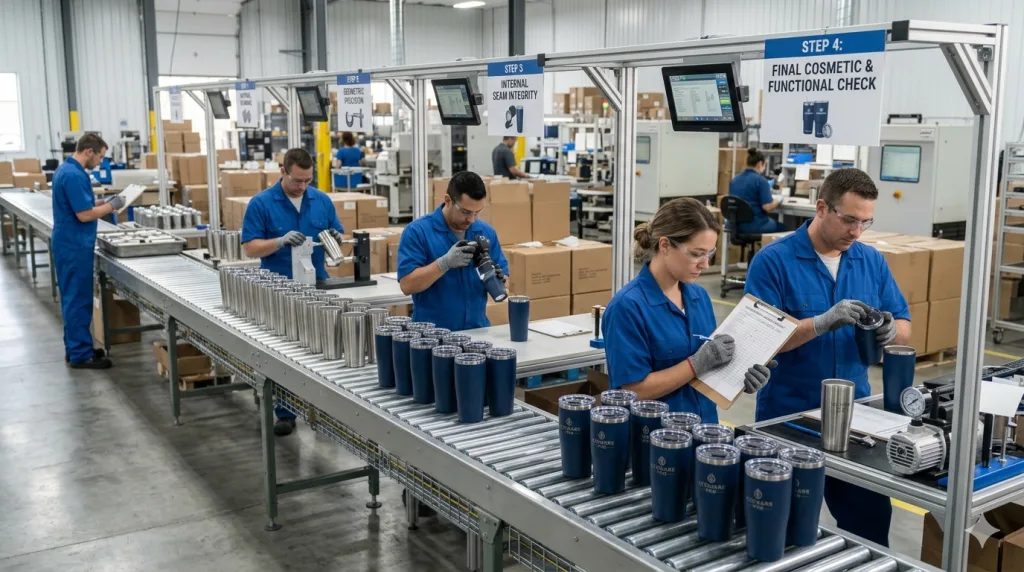
Good QC usually doesn’t happen in one single step. It works better when it follows the order through different stages.
| Stage | What It Checks | Why It Matters |
|---|---|---|
| Incoming material inspection | Steel, lids, seals, coating materials, packaging materials | Stops problems before production gets too far |
| In-line inspection | Production consistency, assembly, printing, coating | Catches repeat defects early |
| Final inspection | Finished product appearance and function | Confirms the batch meets expectations |
| Pre-shipment inspection | Overall shipment readiness | Last chance to stop avoidable losses |
Out of all of these, pre-shipment inspection is usually the most important. Once the goods are loaded and sent out, fixing problems becomes slower, more expensive, and much harder to negotiate.
Surface Quality: The First Thing People Notice
Most buyers notice appearance problems before they notice anything else.
That’s why the body finish should always be one of the first inspection points in your tumbler quality control process.
What to look for:
- scratches on the surface
- dents or body deformation
- uneven powder coating
- paint bubbles or pinholes
- dust marks trapped under coating
- inconsistent color between units
- rough edges around the rim or base
This matters even more if the order is for a premium brand, a retail launch, or custom gifting. Buyers might tolerate tiny cosmetic flaws on low-cost giveaways, but not on a product meant to represent a brand.
Logo and Printing Checks Are Just as Important as Product Function
A tumbler can be structurally fine and still fail the order if the branding is wrong.
This happens more often than people think. Maybe the logo is slightly crooked. Maybe the print size changed from the approved sample. Maybe the color is too light, too dark, or not sharp enough. None of those are major production failures in a factory sense, but for the buyer, they can be the whole reason the batch becomes unusable.
Here’s what should be checked:
- logo placement
- logo size
- correct artwork version
- print clarity
- no fading, smudging, or ghosting
- consistent position across different units
If the order is for private label or corporate gifts, logo accuracy is not a small detail. It is part of the product.
Lid Fit, Seal Quality, and Leak Testing
If there’s one area buyers regret skipping, it’s this one.
A tumbler can look perfect in photos and still become a headache if the lid fit isn’t right. Customers care a lot about how the lid screws on, whether the straw opening feels secure, and whether the tumbler leaks during daily use.
Basic checks should include:
- lid threading feels smooth and not overly tight
- lid sits properly on the cup body
- silicone gasket is installed correctly
- no cracks in plastic lid parts
- straw opening works as expected if included
- basic upside-down leak test
- light shake or movement test after filling with water
Even if the tumbler is not sold as fully leakproof, buyers still expect the seal to perform well under normal use. A weak lid immediately makes the whole product feel cheap.

Don’t Ignore Insulation Performance
People buy stainless steel tumblers for one big reason: they expect them to keep drinks hot or cold for longer.
So yes, insulation should still be part of the checklist.
You do not always need a complicated lab test for every batch, but it helps to confirm that the production lot is consistent with the approved sample, especially if insulation performance is one of your selling points.
At minimum, buyers usually want to confirm:
- there is no obvious vacuum loss
- the double-wall construction feels consistent
- the insulation result is in line with the sample standard
- no units show abnormal heat transfer on the exterior
If your market positioning leans premium, insulation performance should never be left as an assumption.
For product benchmarking, these two pages may help set expectations before mass inspection:
Dimensions, Capacity, and Stability Still Matter
These are easy to overlook because they don’t always stand out visually.
But they matter a lot once the product reaches the customer.
If the base is unstable, the tumbler feels low quality immediately. If the dimensions are off, it may not fit cup holders, packaging inserts, or accessory sets the way it should. If the stated capacity is inaccurate, retail buyers may end up dealing with listing complaints later.
Practical checks include:
- height and diameter
- net weight
- actual usable capacity
- standing stability on a flat surface
- bottom finish and anti-slip components if included
These details sound small, but they shape the everyday experience customers have with the product.
Packaging Inspection Deserves More Attention Than It Usually Gets
One mistake buyers make all the time is focusing only on the tumbler itself.
But packaging failure can ruin an otherwise good order.
You can have a batch of perfectly made tumblers, then still end up with dents, scuffed surfaces, crushed gift boxes, or barcode problems just because the packaging wasn’t checked carefully enough.
That’s why packaging should be part of your tumbler quality control checklist bulk orders, not an afterthought.
Packaging points worth checking:
- individual box quality
- inner insert protection
- carton strength
- correct labels and shipping marks
- barcode readability
- correct quantity per carton
- clean carton sealing
- no obvious carton deformation before loading
This is especially important for Amazon and e-commerce shipments, where warehouse handling is rougher than many new buyers expect.

How Many Tumblers Should You Actually Inspect?
Not every unit gets checked in a normal pre-shipment inspection. Most buyers use sampling standards, often based on AQL.
What matters most is that the sample size is not too small to tell you anything useful.
If you only inspect a handful of pieces out of a large order, you may miss a repeating defect pattern completely. That’s where false confidence starts.
In practice, buyers usually confirm these points before inspection starts:
- inspection level
- sample size
- critical defect definition
- major defect definition
- minor defect definition
- acceptable tolerance level
You don’t need to overcomplicate it, but you do need agreement in advance. Otherwise, the conversation after inspection becomes messy very quickly.
A Simple Way to Think About Defects
Not every defect has the same weight.
That’s why it helps to sort issues into three levels.
Critical Defects
- serious leakage
- sharp edges that could hurt the user
- wrong product shipped
- major contamination or hygiene issue
- missing core parts
Major Defects
- obvious scratches or dents
- misaligned logo
- lid fit problems
- unstable base
- packaging failure likely to damage product
Minor Defects
- small cosmetic marks
- light box scuffs
- tiny print imperfections
- slight color variation within acceptable range
This helps buyers make decisions faster. A batch with too many major defects may need rework. A batch with critical defects should not leave the factory.
Common QC Mistakes Buyers Keep Repeating
Some problems are production-related. Others are buyer mistakes.
And honestly, a lot of preventable losses come from the same habits being repeated:
- approving shipment based only on photos
- checking appearance but not function
- skipping packaging inspection
- not defining standards before production
- inspecting too late
- checking too few samples
- not keeping inspection records
The “photos only” mistake is probably one of the most common. Suppliers usually send pictures of the best-looking units, not the average condition across the whole lot. That doesn’t always mean anyone is being dishonest. It just means photos are not a full inspection method.

A Practical Decision Framework After Inspection
Once the inspection is done, buyers usually end up choosing one of four paths:
- Approve shipment if the batch is within the agreed standard
- Approve with corrections if only minor issues need fixing
- Request rework if defects are repeated but still repairable
- Stop shipment if critical problems are found
That sounds obvious, but many buyers hesitate because they don’t have a decision rule prepared ahead of time. A checklist helps remove that uncertainty.
When a Third-Party Inspection Makes Sense
Not every order needs an outside inspection company. But in some cases, it is absolutely worth the money.
It usually makes sense when:
- the order value is high
- it’s your first order with the supplier
- the product is heavily customized
- the shipment deadline is tight
- you cannot visit the factory yourself
- the tumblers are for retail, Amazon, or important brand campaigns
If the supplier relationship is stable and past quality has been consistent, you may not need third-party inspection every time. But for new projects, it can save far more than it costs.
Email Template You Can Send Before Shipment Inspection
If you want to keep communication clear, something simple like this works well:
Subject: QC Confirmation for Bulk Tumbler Order
Hello,
We are preparing for final inspection for our bulk tumbler order. Please confirm the completed quantity, packaging status, inspection standard, and defect tolerance before shipment.
We would also like confirmation on lid leak testing, logo position check, surface finish check, and carton labeling accuracy. Please provide QC photos and videos after inspection is completed.
Please do not arrange shipment until the inspection result is approved.
Thank you.
Final Thoughts
A good tumbler order is not just about getting the design right. It’s about making sure the full batch still looks right, works right, and arrives in good condition.
That’s really what a tumbler quality control checklist bulk orders process is for.
It protects you from the expensive stuff that tends to show up too late—leaks, coating defects, print problems, weak cartons, inconsistent assembly, and preventable customer complaints.
If you’re buying in volume, QC is not a side task. It is part of the buying decision.
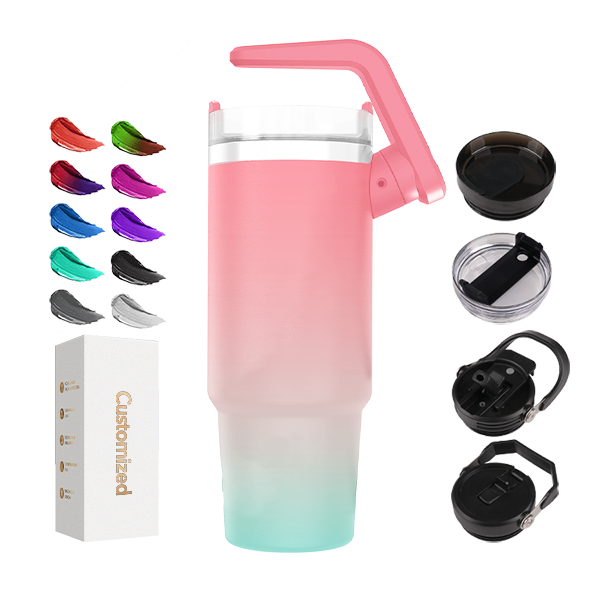
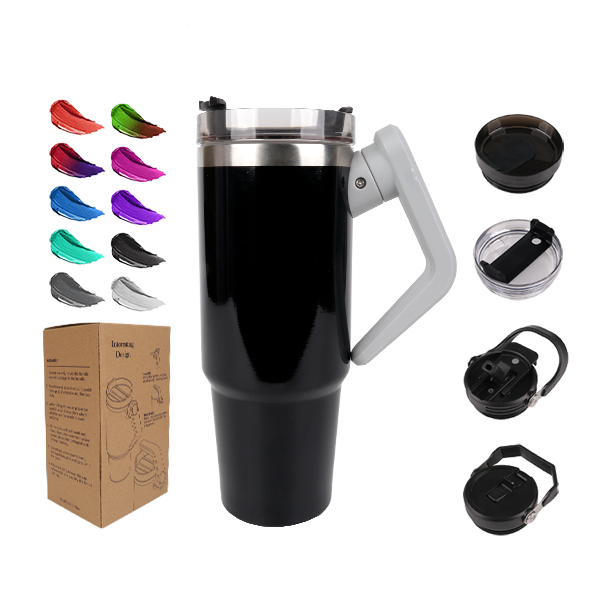
And if you’re looking for a supplier that supports scalable custom production, many buyers start with products like this 30oz custom tumbler for bulk orders, especially for private label, promotional use, and wholesale distribution.
MOQ starts from 50 units, with support for custom logo, packaging, and bulk order inspection workflow.