
Choosing between a 30 oz and a 40 oz custom tumbler changes more than the nominal capacity. For a branded drinkware order, check the exact model’s handle, lid, artwork area, carton size and delivery needs before approving a sample. This guide compares two products currently shown by Coolnice and gives buyers a practical way to specify the order.
30 oz vs 40 oz: quick comparison
| Decision | 30 oz example | 40 oz example |
|---|---|---|
| Nominal size | 30 oz class | 40 oz class; nominally 10 oz more than 30 oz |
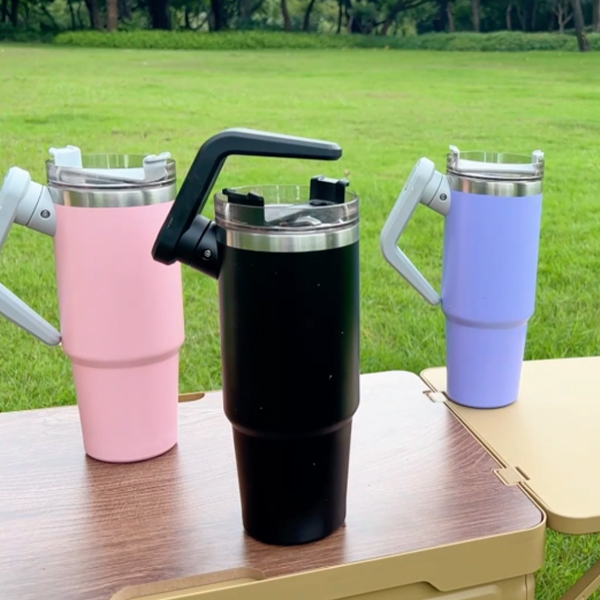
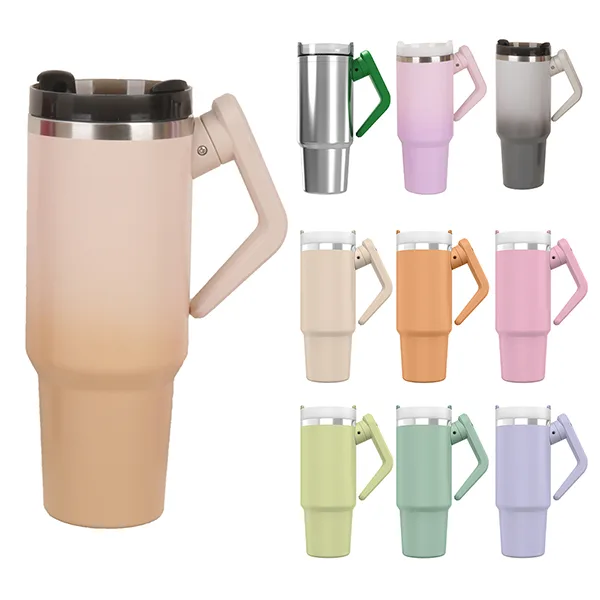
| Model on this site | Coolnice 30 oz rotatable-handle tumbler | Coolnice 40 oz gradient tumbler |
| Listed construction | Stainless steel, double-wall insulation, rotatable handle and straw-compatible lid | 304 stainless steel, double-wall vacuum insulation, handle and straw |
| Typical buying reason | Smaller nominal volume when portability and package size matter | More nominal volume when refill frequency matters more |
| Before ordering | Confirm actual fill volume, empty weight, lid, artwork area, base diameter and carton measurements | Confirm the same specifications for the chosen 40 oz variant |
The 30 oz product URL and heading also use “800ml.” Those labels do not convert exactly, and the 40 oz product description includes a stray “500ml” line. Treat each product’s nominal ounce label as a category name and request the exact usable fill capacity in millilitres on the approved specification sheet. Do not infer dimensions, cup-holder fit or insulation hours from size alone.
See the two starting products
How to choose for your sales channel
Retail or Amazon assortment
Compare a physical sample of each size side by side. Record the empty weight, height, widest diameter, base diameter, lid opening, handle clearance and carton dimensions. Ask for the current packaging options, barcode placement and any labeling requirements for your destination market. A large nominal capacity can affect freight cost and shelf space; quote the actual packed dimensions before deciding.
Promotional gifts and events
Start from the audience and distribution method. A 30 oz unit may suit a brief that prioritizes a smaller carry size; a 40 oz unit suits a brief that prioritizes fewer refills. Confirm the chosen color and logo location with a proof. For event deadlines, request a dated production and shipping plan rather than assuming standard turnaround.
Custom brand programs
Coolnice lists logo and color customization on its 40 oz product page and describes branding on its 30 oz listing. Send vector artwork, target colors and intended printing position. Ask which decoration processes are feasible on the exact finish, whether a sample is needed, and how final artwork approval is recorded.
Specification checklist before a bulk quote
- Choose the exact 30 oz or 40 oz product URL and color or finish.
- Request usable fill capacity in ml and tolerances, plus dimensions and empty weight for that variant.
- Specify lid type, straw and handle; request written leak-resistance and cleaning instructions for the selected configuration.
- Provide logo file, print or engraving location, approximate size and packaging artwork.
- State quantity by variant, destination, required date and packaging format.
- Request a sample or pre-production proof and an itemized quote with shipping terms and lead time.
Ready to enquire? Copy the custom tumbler RFQ template and include both product links if you want a side-by-side quotation. For broader styles, browse Coolnice’s custom tumbler range. Email anna@coolnicetumbler.com with the brief.
Frequently asked questions
Is a 40 oz tumbler exactly 10 oz larger than a 30 oz tumbler?
The nominal labels differ by 10 oz. Actual usable fill volume depends on the model and fill line; ask for a tested ml capacity for each sample.
Will either size fit a car cup holder?
Do not assume so from the ounce label. Ask for the base diameter and check it against the cup holder your customers use. Handles and lid shapes can also affect fit.
Can the same logo artwork be used on both sizes?
Use the same brand artwork as a starting point, then obtain separate placement proofs for each model. The printable area and curvature may differ.