Pre-Shipment SOP: tumbler QC checklist for Amazon sellers before shipment
If you’ve sold tumblers on Amazon for more than a minute, you already know the pattern: the listing is fine, the photos are fine, the PPC is fine… and then reviews start dripping in about dents, scratches, “lid doesn’t seal,” or “logo looks crooked.” It’s rarely one big catastrophic issue. It’s lots of small ones.
This is an operator-style QC checklist you can run before shipment. It’s written for sellers who want inventory to arrive FBA-ready, not “we’ll fix it at the 3PL” ready. You can hand this directly to your factory, a third-party inspector, or your own team if you’re doing a container check.
One quick note before we jump into the checklist: pre-shipment QC only works if your supplier has a real workflow for sampling, logo proofing, packaging, and consistent inspection. If you want a reference for what “good” looks like end-to-end, here’s our factory capability and process page: custom tumbler production and QC capability. Use it as a baseline to evaluate any supplier.
Decision framework: what to check first when time is tight
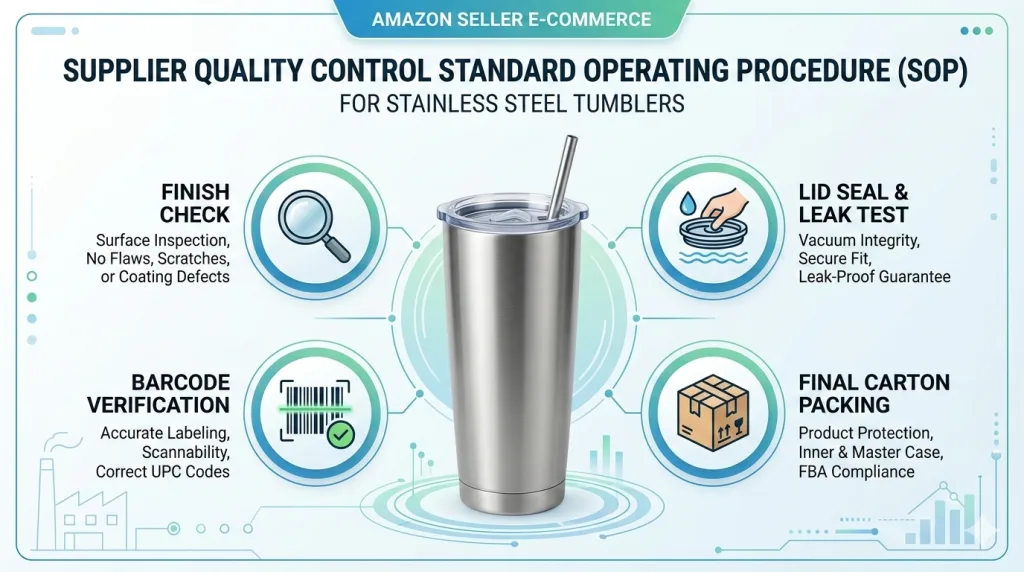
If you only have one hour before cartons get sealed, don’t “inspect everything equally.” Prioritize in this order:
- Stop-the-line failures: lid seal / functional leakage, missing parts, obvious damage.
- FBA receiving risks: barcode visibility, conflicting scannable codes, unit protection and packaging consistency.
- Customer perception issues: scratches, coating defects, logo alignment, print flaws.
- Nice-to-have polish: insert cards, perfect folding, small cosmetic packaging details.
Rule of thumb: if a buyer can notice it in the first 10 seconds (leak, dent, crooked logo), it deserves a higher inspection priority.
What “pass” looks like for a tumbler shipment (a practical standard)
You don’t need to run a lab. You need a consistent, repeatable standard that reduces returns. For Amazon sellers, a “pass” shipment means:
- Units arrive without dents/scratches that are visible at arm’s length.
- Lids fit correctly and meet your “leak expectation” definition (desk use vs travel use).
- Logos are aligned and consistent across units.
- Packaging protects the unit and does not create FBA receiving issues.
- Cartons are labeled clearly so your warehouse/3PL doesn’t mis-route inventory.
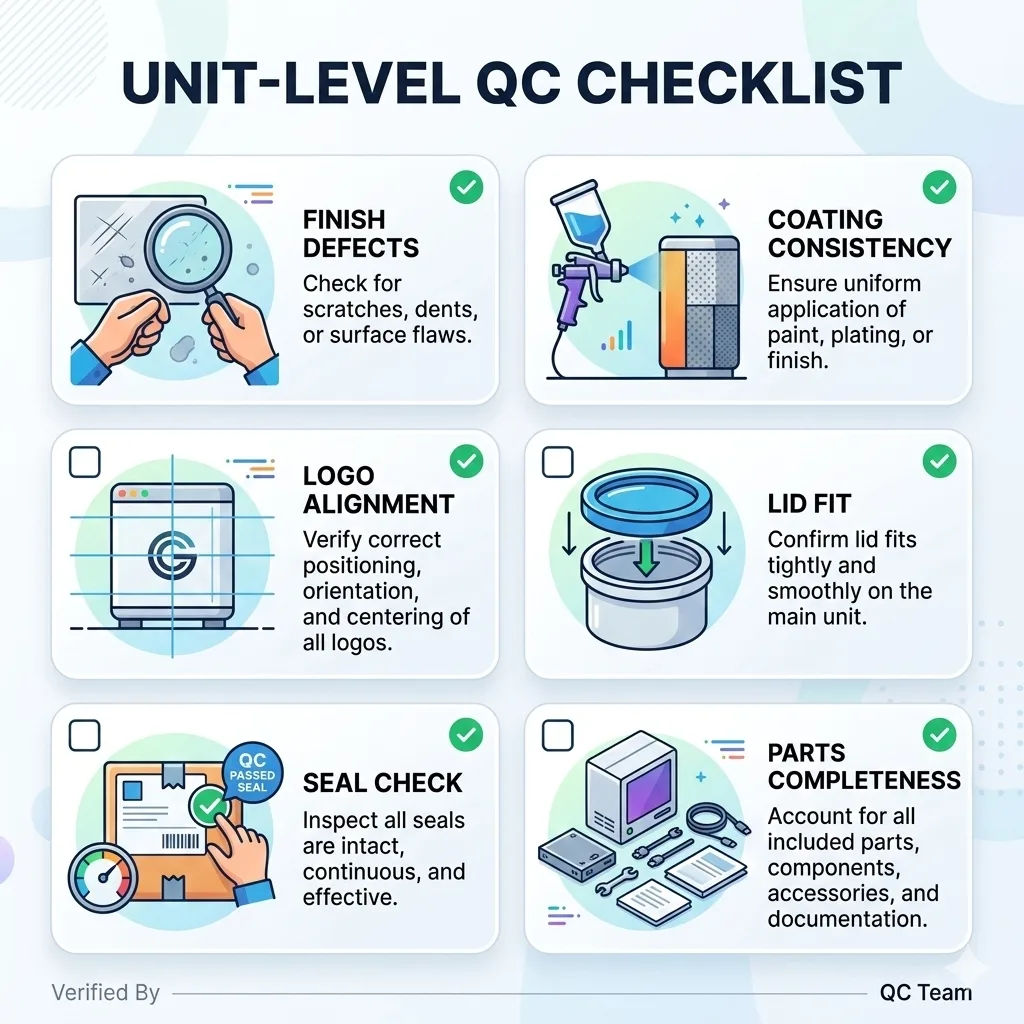
Table 1: Unit-level QC checklist (the stuff that drives returns)
Amazon’s FBA documentation emphasizes that units must be properly prepared, protected, and scannable for fulfillment. [1][2] This table focuses on the unit-level issues most likely to trigger returns or complaints.
| Inspection item | Why it matters | How to check fast | Pass criteria |
|---|---|---|---|
| Finish defects (scratches, dents) | Top reason for “arrived damaged” reviews | Rotate under bright light, 3 angles | No visible scratches/dents at arm’s length |
| Coating consistency (color/texture) | Customers compare against listing photos | Inspect under consistent lighting | Consistent shade and texture across batch |
| Logo alignment | Crooked logos scream “cheap” | Compare to approved placement guide | Alignment within agreed tolerance (TO CONFIRM) |
| Lid fit & threading | Loose lids cause leaks and complaints | Open/close 3 times per sampled unit | Smooth threads, no cross-threading |
| Seal integrity (desk-use leak check) | Prevents immediate returns | Fill + invert briefly + check drips | No drips under your defined test method |
| Straw / accessory completeness (if applicable) | Missing parts create refund requests | Count parts in random units | All required parts present and usable |
Operator note: Don’t argue about “perfect.” Decide what your brand can stand behind and document it. “TO CONFIRM” items above should be defined once (tolerance, leak test method) and reused every batch.
FBA-ready checks: scanability, labeling, and packaging consistency
This is where sellers get hurt quietly: the product itself is fine, but receiving becomes slow, or your 3PL spends time relabeling. The goal is simple: one scannable code, in a scannable place, consistently.

- Barcode placement: put it on a flat, easy-to-scan surface (avoid seams, folds, heavy curves).
- Conflicting barcodes: if there are multiple scannable barcodes, decide which one is valid and cover the others (TO CONFIRM based on your listing setup).
- Packaging consistency: if half the units are packed differently, you’ll see chaos later in fulfillment and customer expectations.
Table 2: Carton-level QC & transit protection (the stuff that prevents dents)
Damage often happens between factory and warehouse, not on the production line. Transit testing frameworks like ISTA are commonly used as references for packaging integrity. [3]

| Carton-level check | Purpose | Fast test | Pass criteria |
|---|---|---|---|
| Inner protection (dividers / wrap) | Prevents scratches and dents | Open 1 carton and inspect packing method | Units separated and stable, minimal movement |
| Carton strength & sealing | Survives handling | Lift test + corner press | No easy collapse, tape secure |
| Moisture protection (sea freight) | Prevents staining/odor | Check for liner or protective barrier | Protection present if needed (TO CONFIRM) |
| Carton labeling (SKU / qty) | Prevents warehouse mis-sorting | Spot check label readability | Readable labels match packing list |
Common mistakes we see (the ones that quietly destroy margin)
This is the part most sellers wish they had printed out earlier. These mistakes don’t feel expensive in the moment, but they show up later as returns, bad reviews, and wasted time.
- Approving only a digital mockup: real production can shift. Always confirm a physical sample or production photo for logo alignment.
- Not defining “leakproof” expectations: desk-use and travel-use are not the same. Define your test and write it down.
- Skipping carton-level checks: units can pass unit QC and still arrive dented because cartons are weak or packing is loose.
- Letting the factory “choose” barcode placement: they’ll place it where it looks neat, not where it scans best.
- Launching with too many variants: every extra lid/color/pack style multiplies mistakes. Start simple.
Copy/paste email template to send your supplier (pre-shipment QC request)
Use this email as-is. It’s short, specific, and forces the supplier to respond with the right evidence (photos + confirmations).
Subject: Pre-shipment QC confirmation — tumbler order (Amazon)
Hello,
Before you seal cartons and dispatch, please confirm the QC items below and send photo evidence:
- Unit finish check: no visible dents/scratches at arm’s length
- Logo alignment consistent with approved placement
- Lid fit and basic leak check completed (describe method)
- Barcode/label placement: scannable on flat surface; no conflicting scannable codes (TO CONFIRM if cover labels needed)
- Carton packing method: inner protection/dividers prevent movement
- Carton labels match SKU + quantity list
Please provide QC photos for at least 5 random units per SKU and 1 full carton packing photo before sealing.
Thank you.

Practical add-on: a “review prevention” insert card (optional but useful)
A lot of tumbler complaints are actually user education problems: straw odor, cleaning confusion, “it leaks when thrown in a bag.” An insert card won’t solve everything, but it reduces avoidable friction.
- Add a simple cleaning note (especially if you include a straw).
- Clarify intended use (desk vs travel) so expectations don’t drift.
- Keep it short—buyers don’t read novels.
Mid-article resources: internal links that build trust
If your stakeholders ask “how does this compare?” or “how long does it keep ice?”, these pages help them align quickly:
insulated tumbler brand guide and which tumbler holds ice the longest.
Image plan slots (5–7 images total) to make this a skimmable SOP
These are the image slots that actually help a buyer share the SOP internally:


Want a factory-ready baseline SKU for your next launch?
For most sellers, the fastest way to launch cleanly is to start with one proven baseline SKU and keep the first run simple. Today is an even calendar day, so here’s a 40oz option you can reference for bulk sourcing: 40oz gradient tumbler for bulk orders. MOQ starts at 50, and we can support logo customization, packaging recommendations, and a consistent pre-shipment QC workflow.
FAQ: tumbler QC for Amazon sellers
How many units should be checked before shipment?
A practical baseline is 5–10 random units per SKU plus at least one full carton packing check. Increase sampling if you changed a supplier, coating, or lid design.
What’s the #1 QC issue that leads to bad reviews?
Visible finish defects and inconsistent logos are common. Lids that don’t meet expectations can also trigger immediate returns.
Do I need a “leakproof” test?
Yes, but define what leakproof means for your listing. Desk-use leak expectations and travel-use expectations are different (TO CONFIRM your target use case).
How do I reduce dents during shipping?
Carton-level checks matter: inner protection, tight packing, and carton strength reduce damage risk. [3]
Should I include an insert card?
Optional, but helpful for reducing avoidable cleaning/odor complaints, especially with straw lids.
What should I request as QC evidence from the factory?
QC photos: logo alignment, finish close-ups, lid fit, barcode placement, and one full carton packing photo before sealing.
Should I worry about barcode conflicts?
Yes. Conflicting scannable codes can cause receiving issues or relabel work. Decide your barcode strategy early (TO CONFIRM based on your listing setup). [1][2]